
If you have attended one of my classes recently, you have probably heard me mention The Yoga Sutras. This ancient text has deeply influenced the way I understand and practice yoga, and I have become increasingly committed to sharing its teachings, not only in yoga teacher training or philosophy workshops, but in regular weekly yoga classes.
Still, I recognize that many yoga students have no idea what The Yoga Sutras actually are. That is completely understandable. Although the Sutras are considered one of the most influential texts in yoga philosophy, most modern yoga classes are far more likely to teach you downward-facing dog than introduce you to a 2,000-year-old collection of teachings about the mind.
So, let’s begin with the basics.
What Are The Yoga Sutras?
The Yoga Sutras are a collection of teachings about the practice and purpose of yoga. Rather than focusing primarily on physical postures, they explore how our minds work, why we suffer, what gets in the way of seeing ourselves and our lives clearly, and how yoga can help us experience greater freedom.
The Sanskrit word sutra is often translated as “thread.” It is related to the English word suture, which describes the stitching together of separate parts. Each sutra is a short thread of wisdom, and together these threads create a larger framework for understanding and practicing yoga.
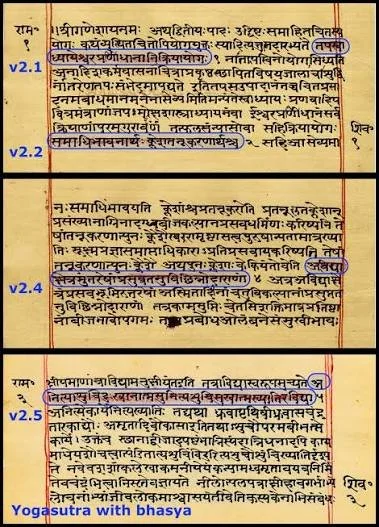
From Wikipedia: Some pages from a historic Yogasutra manuscript (Sanskrit, Devanagari). The verses are highlighted and are embedded inside the bhasya (commentary).
The word sutra can also refer to the concise literary style in which the teachings were recorded. The individual sutras are extremely brief, sometimes only a few words long. They were not intended to explain every idea thoroughly or to function as a modern how-to manual. Their compact structure made them easier to memorize, recite, and pass from teacher to student.
This is one reason the Sutras can feel confusing when we first try to read them. We are essentially reading the condensed notes without hearing the full lecture. Traditionally, a student would have studied them with a teacher who could unpack their meaning and help the student put the teachings into practice. The words provide the framework, but guidance, conversation, contemplation, and personal experience are what bring them to life.
Who Wrote Them?
The Yoga Sutras are attributed to a sage named Patanjali. We know very little with certainty about who Patanjali was, and scholars still debate whether he personally created all of these teachings or collected and organized ideas that had already been circulating through older yoga traditions.
You may also hear Patanjali associated with important works on Sanskrit grammar and Ayurvedic medicine. Traditional accounts sometimes describe these works as belonging to the same great sage, but historians are not certain that they were all written by one person.
For our purposes, I think it is helpful to understand Patanjali as the person traditionally credited with gathering and organizing these teachings into the philosophical system we now call Classical Yoga.
When and Where Were They Written?
The Yoga Sutras were composed in ancient India, but there is no universally agreed-upon date. Estimates vary widely, although many scholars place the text somewhere within the first few centuries of the Common Era. Some contemporary scholarship dates the combined work to around 400 CE, while other scholars believe portions of it may be several centuries older.
In other words, it is completely fair to call the Sutras approximately 2,000 years old, but it is difficult to attach a precise publication date to a text that emerged in a very different literary and teaching culture than our own. The teachings likely grew out of ideas and practices that had been shared orally long before they were preserved in the form we now recognize.
Sutra Organization
Most modern editions contain 196 sutras, although some traditions count 195. The difference is generally a matter of how one particular passage is divided, not that an entire teaching has disappeared.
The sutras are organized into four sections called padas. Pada can be translated as “chapter,” “portion,” or even “foot,” suggesting one part of a larger journey.
The first is Samadhi Pada, the chapter on contemplation or meditative absorption. This section defines yoga, describes the activity of the mind, and introduces practices that help quiet mental fluctuations. It also explores samadhi, a state of deep concentration and clear awareness.
The second is Sadhana Pada, the chapter on practice. Sadhana refers to a deliberate spiritual practice or path. This chapter contains some of the Sutras’ most familiar and applicable teachings, including Kriya Yoga, the causes of suffering, and the Eight Limbs of Yoga.
The third is Vibhuti Pada, the chapter on extraordinary capacities or accomplishments. It explores the final three limbs of yoga (concentration, meditation, and absorption) and describes abilities that may arise through intense mental discipline. It also warns that becoming overly attached to these abilities can distract us from yoga’s deeper purpose.
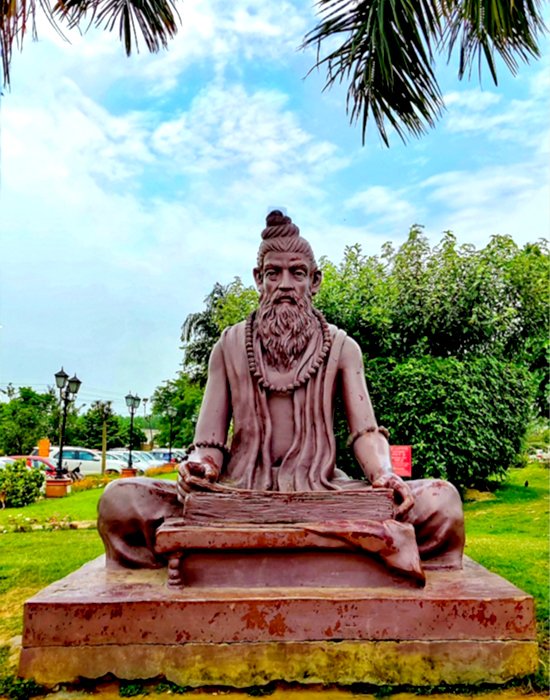
Statue of the sage Patanjali (attributed author of the Yoga Sutras)
The fourth is Kaivalya Pada, the chapter on liberation or freedom. This section explores the nature of consciousness and the ultimate goal of yoga: freedom from the patterns, confusion, and misidentifications that keep us from seeing clearly.
In my classes and writing, we will spend most of our time exploring the first two padas. These chapters contain many of the teachings that feel most practical and relatable to everyday life. They help us work with our thoughts, habits, relationships, suffering, reactions, and choices. They are also the sections most commonly introduced in yoga teacher training programs, particularly because the second pada contains the Eight Limbs of Yoga.
It’s not that the third and fourth padas are unimportant. They just move into ideas that can feel more abstract and, in the case of extraordinary yogic powers, a little harder for the average modern student to relate to. I believe there is more than enough wisdom in the first two chapters to support a lifetime of practice.
What’s up the commentaries?
Because the sutras themselves are so brief, commentaries have always played an important role in how they are understood. In the traditional telling, the earliest surviving commentary is attributed to Vyasa and dated to around the fourth or fifth century CE. Many later teachers and scholars built their interpretations upon it.
A brief note worth mentioning here: some contemporary scholars believe the sutras and their earliest commentary may originally have been composed as a unified work rather than written by two people centuries apart. As is the case with a lot of ancient history, there is still plenty we don’t know for certain but that should not distract us from the overall value of this text.
What we do know is that no one approaches these short, complex teachings without some level of interpretation. A Sanskrit word may have several possible meanings, and the translator’s time period, culture, spiritual tradition, and personal experience all influence the English words they choose.
This is why there are now so many translations and commentaries on The Yoga Sutras and why they can sometimes sound different from one another. I don’t see this as a problem. Reading several interpretations can help us view the same teaching from different angles and notice what resonates, what challenges us, and what we might otherwise have missed.
“The only true voyage … would be not to visit strange lands but to possess other eyes, to see the universe through the eyes of another.”
Translations I Love
One of the first versions I studied was Sri Swami Satchidananda’s The Yoga Sutras of Patanjali. It is one of the most widely read modern commentaries used in many 200 hours yoga teacher trainings, including mine! I appreciate how directly and practically he relates the teachings to everyday life. I have used many of his stories in my yoga classes over the years.
I also love Nicolai Bachman’s The Path of the Yoga Sutras. Rather than moving through all 196 sutras in their original order, Bachman organizes the teachings around key concepts. This makes the philosophy approachable and helps connect Sanskrit terms with their practical meaning. I also enjoy that he offers prompts at the end of each chapter to help you reflect and integrate the concepts.
T.K.V. Desikachar’s The Heart of Yoga has also been deeply influential for me. It is not solely a book about the Sutras, but it includes a translation and commentary while placing the teachings within the context of developing a personal yoga practice. The emphasis on adapting yoga to the individual has greatly shaped the way many modern teachers understand and share the practice. The history and personal takes he adds are especially valuable as his dad was Tirumalai Krishnamacharya, the father of modern postural yoga and one of the reasons we all practice in America today!
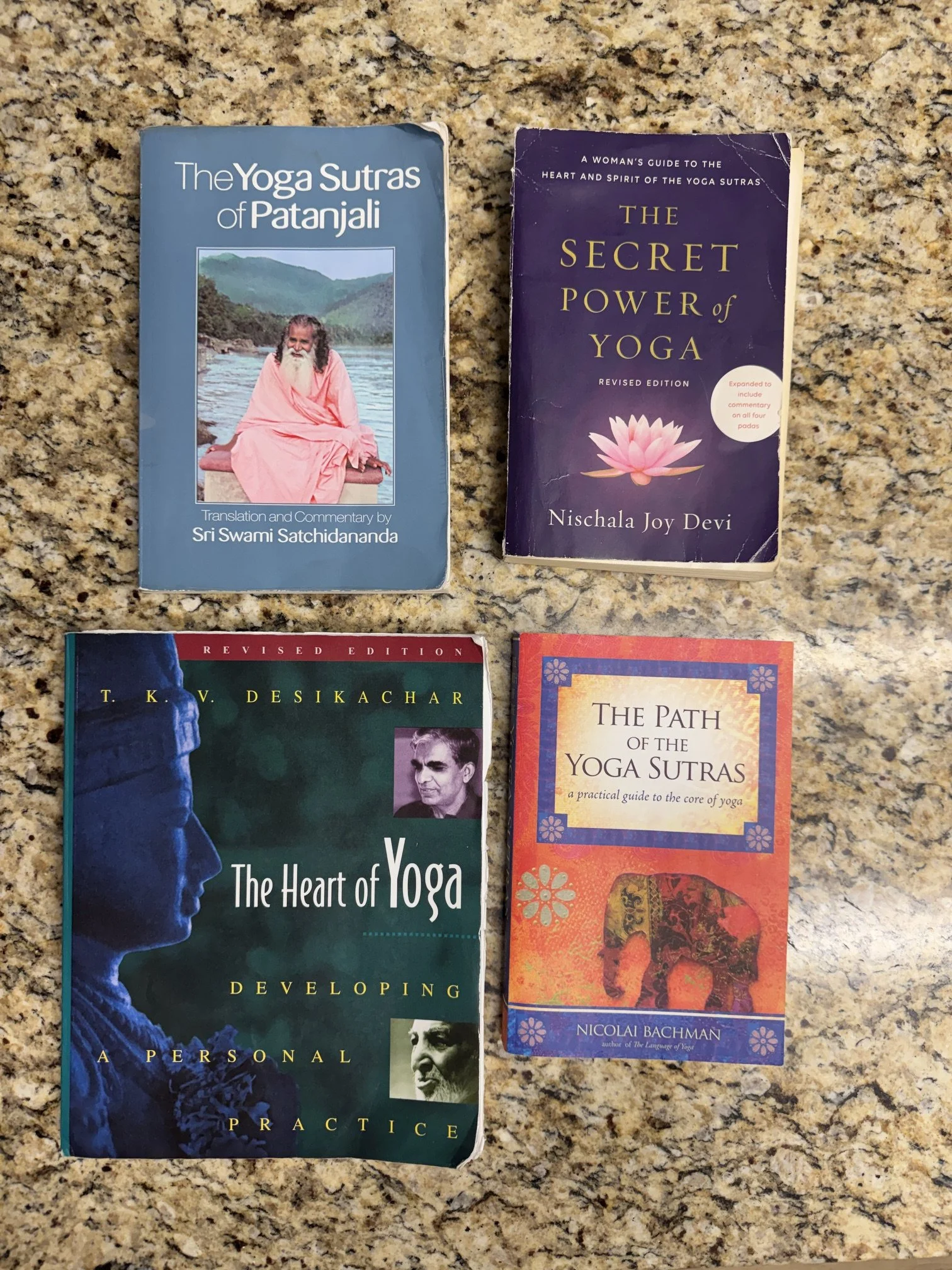
My favorite Yoga Sutra books
Most recently, I have been reading Nischala Joy Devi’s The Secret Power of Yoga: A Woman’s Guide to the Heart and Spirit of the Yoga Sutras, and it has become my favorite interpretation so far. It is the first version I have studied that was written from a distinctly female perspective, and it feels noticeably more heart-centered than many traditional translations.
Devi brings forward themes of love, relationship, compassion, intuition, and connection in places where other translations may emphasize control, restraint, or discipline. I don’t necessarily believe that one translation must be declared the single “correct” interpretation. Instead, her work has helped me hear familiar teachings in a new way—and has reminded me of how much the perspective of the person interpreting a text matters.
Why Study the Sutras Today?
It is reasonable to wonder why we should spend time studying a text written in ancient India when our modern lives look so radically different. Patanjali certainly wasn’t dealing with email, social media, overpacked calendars, or a twenty-four-hour news cycle.
But he was studying the human mind and the human mind has not changed as much as the world has.
We still become consumed by our thoughts. We still mistake our fears and assumptions for reality. We still cling to what feels pleasurable, resist what feels painful, repeat patterns that make us unhappy, and struggle to see ourselves clearly. We still long for peace while participating in habits that disturb it.
The Yoga Sutras give us a framework for understanding these patterns and practices for working with them. They invite us to become more aware of what is happening inside us, to respond to life with greater clarity, and to loosen the grip of the habits that create unnecessary suffering.
That is why these teachings continue to matter. They are not simply historical information to memorize or spiritual ideas we are required to believe. They are an invitation to observe, practice, and discover for ourselves what helps us live with greater steadiness, freedom, wisdom, and heart.